
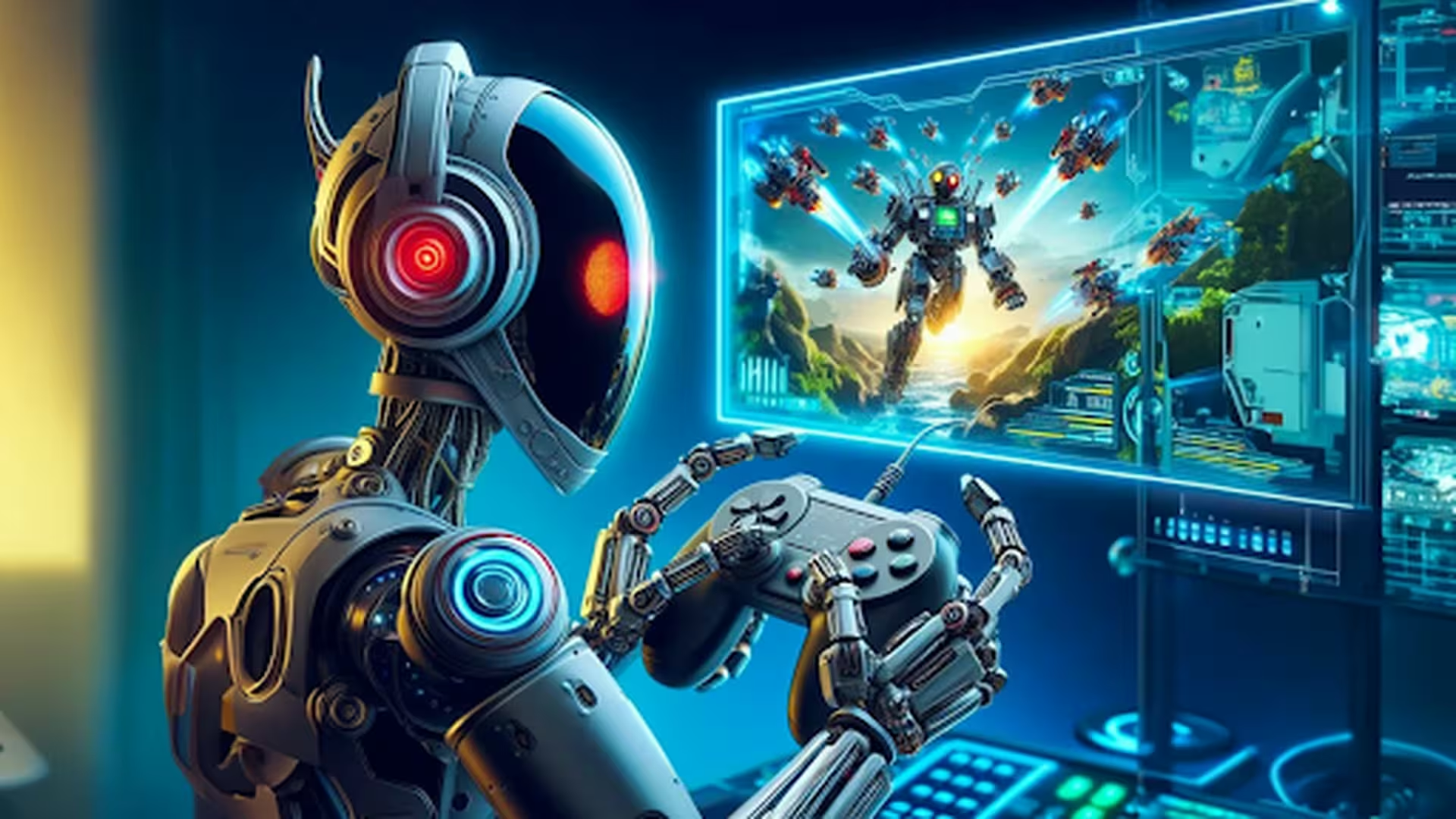
Artificial intelligence now drives modern gaming, evolving from fixed behavior to adaptive, generative systems shaping stories and open worlds.
AI shapes how we experience games, interact with NPCs, and how games evolve over time and space. The industry is undergoing not so much a technological revolution as a cultural transformation. And this process is only gaining momentum.
Early video game AI relied on simple algorithms, with enemies following fixed paths, preset rules, or limited randomness.
This approach made sense because computing resources were limited, and simple rules gave the impression of a “smart” and “quick-witted” enemy.
In the 1980s, AI entered mass-market games as a practical tool for controlling enemy behavior. Classic arcade games like Space Invaders and Pac-Man used extremely simple but effective models.
Enemies followed fixed rules, adjusting movement patterns based on the player’s position or game state. It was the limitations of these algorithms that created the illusion of character. The ghosts in Pac-Man seemed different not because of the complexity of the AI, but because of excellent behavior tables.
On home computers and consoles of the same period, AI also began to perform a balancing function. Due to limited processor resources, enemies often “cheated” the player by having access to information that the player could not see. For example, the exact position of a character or hidden parameters. This did not make them smarter, but it allowed them to create a challenge without costly calculations. This approach has remained in many genres for decades to come.
First-person shooters from the late 1990s, particularly Half-Life, established another important principle: contextual behavior. Enemies reacted not only to the player but also to their surroundings, using cover, retreating under fire, and signaling to allies. This was still based on scripts, but they now worked as a system rather than a linear scenario. Players no longer felt triggers and began to perceive NPCs as “actors” on an improvised game stage.
Open-structure games required AI to function without strictly defined scenarios.
In Thief and Deus Ex, enemies reacted to sound, light, and player traces.
The AI patrolled, searched, erred, and reset, creating a living world without complex learning algorithms.
As of early 2026, game AI is in a strange but telling state. It is ubiquitous but almost invisible. AI controls enemy behavior, event pacing, animations, testing, localization, and even marketing, but rarely acts as the main feature of gameplay itself. The most successful games still rely on proven approaches: behavior trees, scripts, and priority systems, supplemented by modern automation tools.
According to recent industry research, more than 87% of game developers already use AI agents to automate various parts of development, from content optimization to media resource generation and NPC behavior. This demonstrates the scale and depth of artificial intelligence implementation in the development of AAA projects and indie titles.
AI is also becoming an important tool for automating content creation, including text, music, NPC voices, visual resources, and even marketing assets.
Some games on the Steam platform already declare the use of generative AI to create parts of their content, and this trend is growing exponentially.
A separate trend is adaptive AI, which adjusts the difficulty and content to the player’s style. Such systems analyze skill level, weapon selection, and tactics to change enemy behavior or suggest gameplay challenges that maintain a balance between difficulty and interest.
Scientific approaches such as Reinforcement Learning or Proximal Policy Optimization allow NPCs to independently learn optimal actions in the game world. In other words, these are models that can learn from experience.
Despite progress, games using unchecked AI-generated content face criticism and negative reviews due to poor or unsuitable quality.
This brings us back to reality, because the technology is not yet perfect, and its implementation must be well thought out.
AI is also actively used to generate textures. Models can synthesize high-quality materials from low-resolution samples or create variable surfaces based on stylistic cues. This not only saves artists time, but also allows a single team to generate content that previously required dozens of specialists.
In character animation, artificial intelligence is used to improve the naturalness of movements. The combination of motion capture and neural networks allows NPCs to move smoothly even in complex situations, such as when interacting with objects or other characters. The result looks more organic than older scripted animations, where any contact with objects often looked unnatural.
AI also affects dynamic lighting and particle effects. Models predict the behavior of shadows, light reflections, and scattering, allowing for a more realistic atmosphere without static presets. This opens up opportunities to create worlds that look alive and change along with the player’s actions.
Artificial intelligence will become an even more integral part of gameplay and game development in the coming years.
Adaptive AI, procedural generation, and generative content are expected to spread across all game genres.
The idea of fully dynamic, unique open worlds remains wishful thinking, more presentation hype than reality.




Discussion (0)